Enzyme Exfoliant Powders vs Acid Exfoliants: Formulation Tradeoffs for Skincare Brands
For skincare brands, exfoliation is no longer a single-lane decision between “strong” and “gentle.” The manufacturing reality is more specific: pH window, water exposure, preservative compatibility, fill behavior, skin-feel, consumer instructions, stability profile, and batch-to-batch consistency all shape what kind of exfoliant can be produced reliably.
Acid exfoliants remain powerful tools for leave-on and rinse-off formats. Enzyme exfoliant powders offer a different route: water-activated exfoliation with a softer sensorial narrative and strong compatibility with powder-to-foam, mask, cleanser, and professional powder formats. For a cosmetics manufacturer, the right choice depends less on trend language and more on the formula architecture.
Corneora supports brands and factories as an enzyme supplier for cosmetic exfoliant manufacturing, with practical attention to formulation behavior, documentation, and scale-up handling.
The core difference: continuous acidity vs controlled activation
Acid exfoliants such as AHAs, BHAs, and PHAs function through formula acidity. Their performance is closely tied to final pH, acid type, concentration, neutralization strategy, and contact time. The exfoliating system is active within the finished product matrix and must be managed through pH control, irritation-positioning, packaging compatibility, and regulatory labeling discipline.
Enzyme exfoliant powders work differently. Proteolytic enzymes are typically kept in a low-water or dry environment until use. The consumer activates the powder with water during application, creating a short-use window where the enzyme can interact with surface protein structures on the stratum corneum. This makes the format highly attractive when the brand wants a refined, fresh-activation experience and a milder perceived exfoliation story.
Formulation tradeoffs at a glance
| Decision area |
Enzyme exfoliant powders |
Acid exfoliants |
| Primary control point |
Moisture protection, enzyme compatibility, activation feel |
Final pH, acid balance, neutralization, irritation profile |
| Best-fit formats |
Powder cleanser, powder mask, enzyme polish, water-activated treatment |
Toner, serum, peel, gel, cleanser, mask |
| Sensory direction |
Silky, creamy, soft polish, fresh activation |
Tingle, clarity, resurfacing, bright finish |
| Stability focus |
Dry blend uniformity, humidity control, packaging barrier |
pH drift, color/odor shift, preservative and container compatibility |
| Scale-up concern |
Blend homogeneity, dust control, heat exposure, moisture pickup |
pH adjustment, order of addition, corrosion risk, filling compatibility |
| Consumer experience |
Mix-to-activate ritual, lower aggressive perception |
Ready-to-use precision, stronger active positioning |
pH window: why enzymes are not “set and forget”
A common misconception is that enzyme powders remove pH complexity. They do not. Enzymes still have a preferred operating pH window, and the reconstituted product environment matters. If the powder is blended with surfactants, clays, starches, buffers, or botanical powders, the wetted pH can shift the perceived performance and skin feel.
For manufacturers, this means the development brief should define:
- Target wetted pH range after consumer activation
- Buffering strategy, if needed
- Compatibility with cleansing bases or mask minerals
- Sensory target after water addition: creamy, foaming, cushiony, or polish-like
- Expected contact time and rinse behavior
Acid exfoliants are even more pH-sensitive because acidity is the core performance driver. A beautiful acid serum can lose its positioning if pH drifts, if neutralization is inconsistent, or if the formula becomes too sharp for the intended consumer segment.
Stability: water is the dividing line
Enzyme powders are attractive because the enzyme is protected from continuous water exposure. A well-designed powder can offer strong shelf-life potential when moisture is controlled through raw material selection, low-humidity processing, and suitable packaging.
However, enzyme systems are not automatically stable. They require careful attention to:
- Hygroscopic excipients
- Fragrance and essential oil compatibility
- Trace moisture in clays, starches, and botanical powders
- Processing temperature
- Packaging barrier performance
- Warehouse humidity and transport conditions
Acid exfoliants shift the stability conversation toward formula pH, preservative robustness, discoloration, odor development, viscosity change, and interaction with pumps, liners, labels, and closures.
Skin-feel and brand positioning
Acid exfoliants often communicate visible refinement, glow, and resurfacing. They can also bring a recognizable tingle that some consumers associate with efficacy. For brands positioned around high-performance dermatological cues, acids can be highly effective.
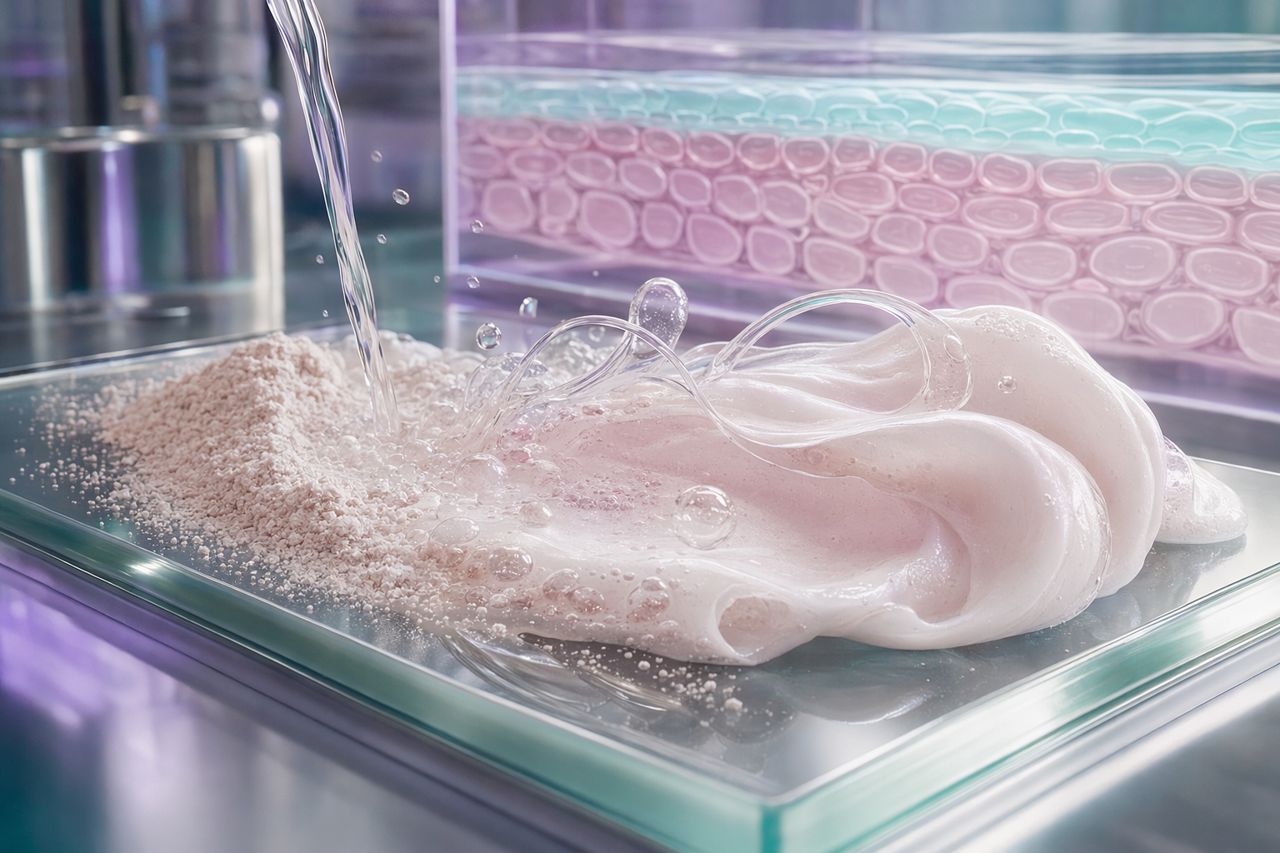
Enzyme powders create a different sensorial contract. The consumer pours, wets, and transforms the powder into a soft paste, foam, or cream. This ritual supports language around controlled exfoliation, smoothness, and skin-forward refinement without relying on sharp acidity as the central experience.
For premium powder exfoliants, the sensory system matters as much as the enzyme selection. Particle feel, slip, water uptake, foam quality, and rinse cleanliness determine whether the product feels elegant or merely functional.
Manufacturing behavior: powders demand physical discipline
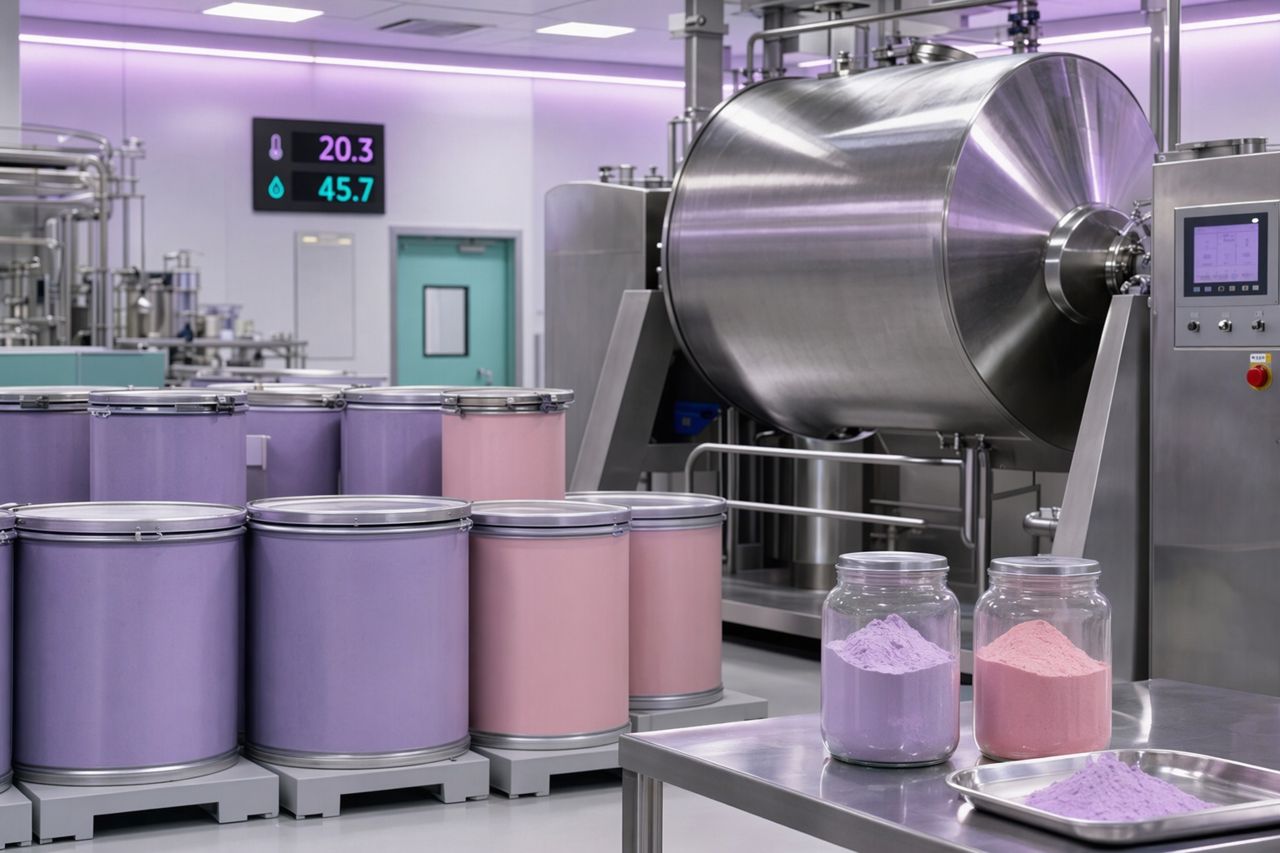
Enzyme exfoliant powders are deceptively simple on paper: dry ingredients blended and filled. In production, they require control.
Key factory considerations include:
- Blend uniformity: Enzymes are often used at low inclusion levels relative to the full powder base, so distribution must be validated through practical in-process controls.
- Dust and handling: Powder flow, airborne dust, and operator exposure should be managed with appropriate processing design.
- Heat exposure: High-temperature processing or aggressive milling can reduce enzyme performance.
- Moisture pickup: Open handling time, ambient humidity, and packaging delays can affect finished-product consistency.
- Filling performance: Fine powders, clays, surfactant powders, and starches can bridge, cake, or flow unevenly without the right particle-size strategy.
Acid exfoliants are typically more familiar to liquid-processing lines, but they bring their own manufacturing controls: pH adjustment sequence, corrosion awareness, mixing order, viscosity stability, and compatibility with preservatives and fragrances.
Documentation: what B2B buyers should request
For cosmetic exfoliant manufacturing, enzyme supply should come with documentation that supports development, quality, and customer-facing compliance review.
A practical documentation pack may include:
- Technical data sheet with recommended handling and formulation guidance
- Safety data sheet
- Allergen and regulatory statements where applicable
- Origin and composition details relevant to the brand brief
- Lot traceability
- Storage and shelf-life recommendations
- Compatibility guidance for cosmetic formats
- Support for pilot-batch troubleshooting
For acids, documentation should also support concentration declaration, cosmetic-use suitability, safety review, and any market-specific restrictions relevant to the finished product.
When enzyme powders are the better choice
Enzyme exfoliant powders are especially compelling when the brand wants:
- A water-activated ritual rather than a ready-to-use serum
- A softer exfoliation story with refined skin-feel
- Powder cleanser, polish, mask, or professional mix-at-use formats
- Reduced dependence on low-pH sensory cues
- Strong shelf-life potential through low-water design
- A premium, clean-rinse experience with controlled polish
They are not ideal when the brief requires a transparent liquid, a leave-on acid profile, or a formula where consumers expect measurable acidity as part of the concept.
When acid exfoliants are the better choice
Acids may be the better path when the brand wants:
- A ready-to-use toner, serum, gel, or peel
- A clear low-pH performance story
- Strong resurfacing positioning
- Established consumer recognition around AHA, BHA, or PHA systems
- Simple dosing instructions without consumer mixing
The tradeoff is a higher need for pH precision, irritation management, packaging compatibility, and careful market positioning.
Can enzymes and acids be combined?
They can be, but the formulation logic must be deliberate. A low-pH acid environment may not be suitable for every enzyme system, and water exposure can reduce enzyme stability in conventional liquid formats. Hybrid systems are more realistic when the product architecture protects the enzyme until use, or when the acid level and pH are designed around compatibility rather than marketing density.
For factories, the key question is not “Can we add both?” It is “Can both remain meaningful, stable, and pleasant in the finished product?”
Practical development checklist
Before selecting an exfoliant system, align these points across R&D, marketing, quality, and purchasing:
- What format is the product: powder, cleanser, mask, serum, toner, gel, or peel?
- Is the exfoliation experience meant to feel tingly, creamy, silky, foaming, or polish-like?
- What is the intended pH range at use?
- Will the enzyme or acid be exposed to water during shelf life?
- What packaging barrier or dispensing system is planned?
- What claims language is realistic for the market?
- What stability risks are most likely: moisture, pH drift, odor, color, viscosity, or caking?
- What documentation is required for internal approval and customer review?
- How will pilot results translate to production scale?
Corneora’s view
Enzyme exfoliant powders and acid exfoliants are not interchangeable. They create different formulation systems, different sensory expectations, and different manufacturing risks. Enzyme powders are strongest when the goal is controlled activation, refined skin-feel, and powder-format elegance. Acid exfoliants are strongest when the goal is ready-to-use acidic resurfacing with familiar consumer recognition.
The best skincare launches come from choosing the exfoliation mechanism that fits the product architecture—not forcing a trending ingredient into the wrong base.
Request a quote
Developing an enzyme exfoliant powder, enzyme cleanser, or water-activated cosmetic polish? Share your target format, pH direction, sensory profile, packaging plan, and production scale through the on-site request a quote form. Corneora can help you evaluate enzyme options, handling requirements, and documentation needs for cosmetic manufacturing.