Enzymes in Rinse-Off Skincare | Corneora
A practical guide for cosmetics manufacturers developing enzyme rinse-off exfoliants, masks, cleansers, and hybrid polishes with controlled skin-feel, pH fit, stability, and scale-up behavior.
Request pricing A practical guide for cosmetics manufacturers developing enzyme rinse-off exfoliants, masks, cleansers, and hybrid polishes with controlled skin-feel, pH fit, stability, and scale-up behavior.
Request pricingRinse-off skincare gives cosmetic formulators a useful design space. The product can deliver a clear exfoliation story, a smoother after-feel, and a more refined cleansing experience without requiring the same residence time expectations as leave-on skincare. For factories, however, enzymes are not just a marketing ingredient. They are processing-sensitive functional materials that need the right pH window, moisture strategy, temperature exposure, and compatibility planning.
Corneora supports cosmetics manufacturers developing enzyme cleansers, rinse-off masks, polishing creams, shower treatments, powder-to-foam systems, and hybrid exfoliant formats. As an enzyme supplier for cosmetic exfoliant manufacturing, we focus on the practical details that decide whether a concept remains elegant after scale-up: activity retention, texture behavior, batch consistency, documentation readiness, and consumer language that stays aligned with the formula’s real mode of action.
{{< faceless-explainer-video id="rinse-off-skincare-enzyme-control" title="Rinse-off skincare enzymes: formulation control in one minute" >}}
Rinse-off formats can position enzymes as a controlled, skin-forward exfoliation technology. They help support the loosening and removal of dull surface buildup while preserving a softer sensory profile than many abrasive-heavy systems.
For a manufacturing team, the advantage is not only the consumer story. It is the ability to build exfoliation performance around variables the lab can manage:
The strongest enzyme rinse-off products feel sensorial at the sink and disciplined in production.
Cream cleansers and balm-to-milk systems can carry an enzyme exfoliation story while maintaining a plush, conditioned after-feel. The key is compatibility. Enzymes need to be selected with the surfactant system, emulsifier package, oil phase, preservative strategy, and water availability in mind.
A factory chemist should evaluate whether the enzyme remains suitably protected during storage, whether processing temperature affects performance, and whether the formula’s pH is within the intended working range. In premium cleansing formats, the enzyme should not create an aggressive or unstable product experience. It should support a refined, repeatable sensation of skin smoothness after rinsing.
Masks provide a clearer contact-time ritual, making them one of the most intuitive homes for enzyme exfoliation. Clay masks, gel masks, cream masks, and powder masks can each use enzymes differently.
In a clay mask, attention should be paid to adsorption, water phase behavior, and preservative compatibility. In a gel mask, the focus often shifts to pH, viscosity stability, and clarity or translucency. In powder masks, the formulation question becomes controlled activation: the product should remain stable in the container, then awaken predictably when mixed with water.
For manufacturing, the goal is repeatable sensorial performance: a mask that feels smooth on application, rinses cleanly, and gives consumers a perceivable but comfortable exfoliation cue.
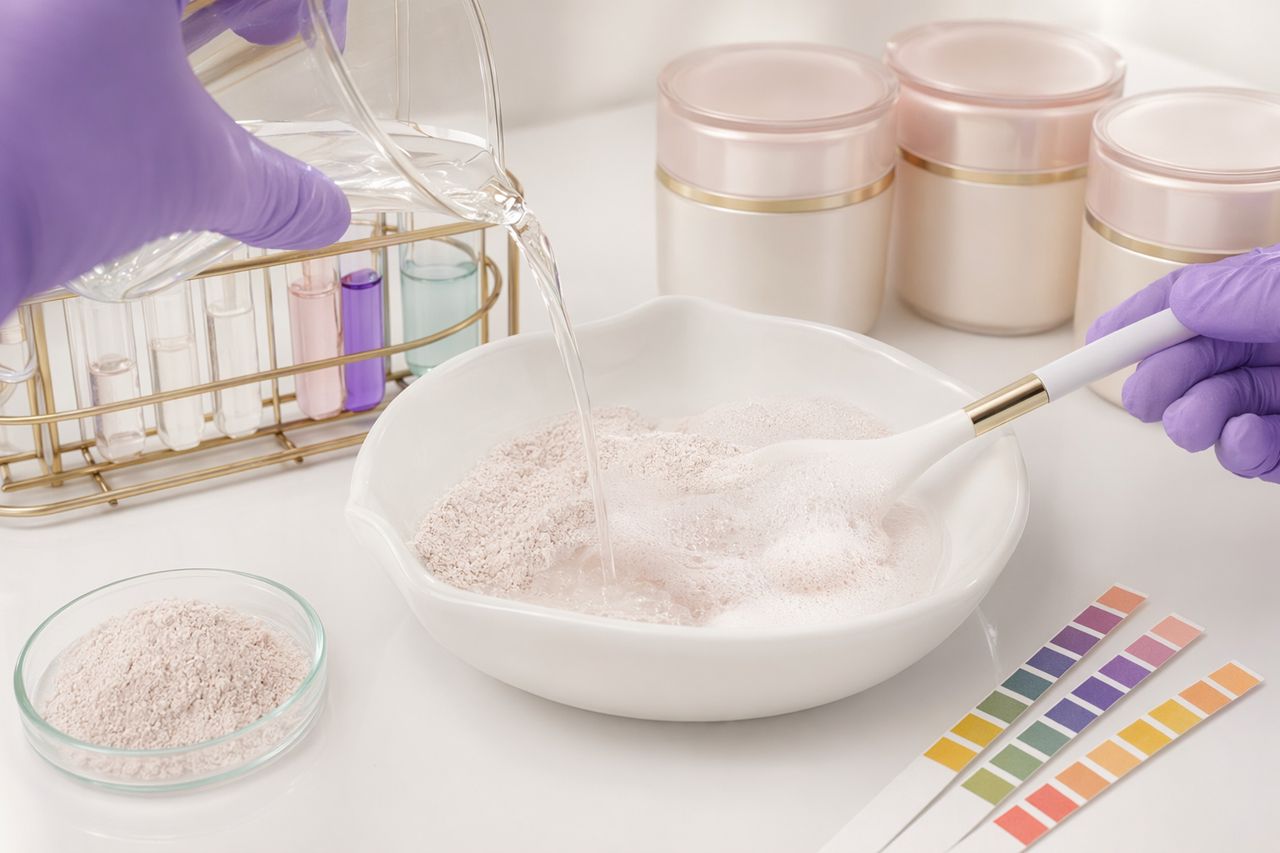
Powder formats are highly attractive when the development team wants improved enzyme protection before use. They also support elegant consumer language around freshness, activation, and customized texture.
However, powders introduce factory realities of their own. Particle size distribution, dust control, blending uniformity, moisture control, packaging barrier, and flow behavior all matter. A strong powder enzyme cleanser does not simply contain an enzyme. It protects the enzyme, disperses evenly, and activates in a way consumers can repeat every time.
For contract manufacturers and brand owners, this is where supplier support becomes commercially valuable. The enzyme grade, carrier system, and handling guidance can influence both production efficiency and the final user experience.
Many brands combine enzymes with fine polishing particles for a dual-action exfoliant story. This can work well when the physical phase is gentle, uniform, and aligned with the enzyme’s role. The risk is overbuilding the formula: too much abrasive character, too much fragrance intensity, or a pH environment that compromises enzyme function.
The best hybrid systems feel controlled. The enzyme brings a biochemical refinement story. The particles add immediate sensory feedback. The base keeps the experience cushioned and easy to rinse.
Enzymes in rinse-off skincare can support strong product storytelling, but the language should stay cosmetic, measured, and formulation-true. Manufacturing teams often need to help marketing teams choose language that is attractive without drifting into unsupported claims.
Useful cosmetic language may include:
Language to handle carefully includes claims that imply medical treatment, structural skin change, or guaranteed biological effects beyond the cosmetic use context. The formula, test plan, and regional claim rules should guide final wording.
Corneora helps technical buyers bridge the gap between ingredient function and finished-product language. That means selecting enzyme materials that fit the formulation, then describing their role in a way that supports the brand concept without overstating the science.
Enzyme performance is strongly tied to pH. A formula may look beautiful, pass early stability, and still underperform if the pH sits outside the enzyme’s practical operating range. For rinse-off skincare, formulators often work in mildly acidic to near-neutral territory, but the right target depends on the enzyme class, the base, the product format, and the desired skin feel.
The practical question is not “Can we add an enzyme?” It is “Can this formula environment let the enzyme behave predictably through shelf life and at use?”
Enzymes need the right environment to function, yet too much available water in-pack may shorten usable activity depending on the format. This makes water strategy central to enzyme product design.
Anhydrous and powder systems often focus on protection before use. Emulsions and gels focus on compatibility and stability in the finished base. Masks and cleansers may rely on controlled contact time and rinse behavior to create the intended experience.
Some cosmetic manufacturing processes involve heated phases, hot filling, extended mixing, or warm warehouse exposure. Enzymes should not be treated like decorative additives. Addition point, cooling stage, hold time, and post-addition mixing can all influence finished-product consistency.
A practical supplier conversation should include the intended manufacturing flow, not just the INCI list.
Rinse-off formulas often carry surfactants, solubilizers, preservatives, fragrance, botanical extracts, chelators, salts, and texture modifiers. Any of these can affect the enzyme environment or finished-product feel.
This does not mean enzyme formulas must be fragile. It means compatibility should be designed, not assumed. The right grade selection and formulation architecture can reduce avoidable development loops.
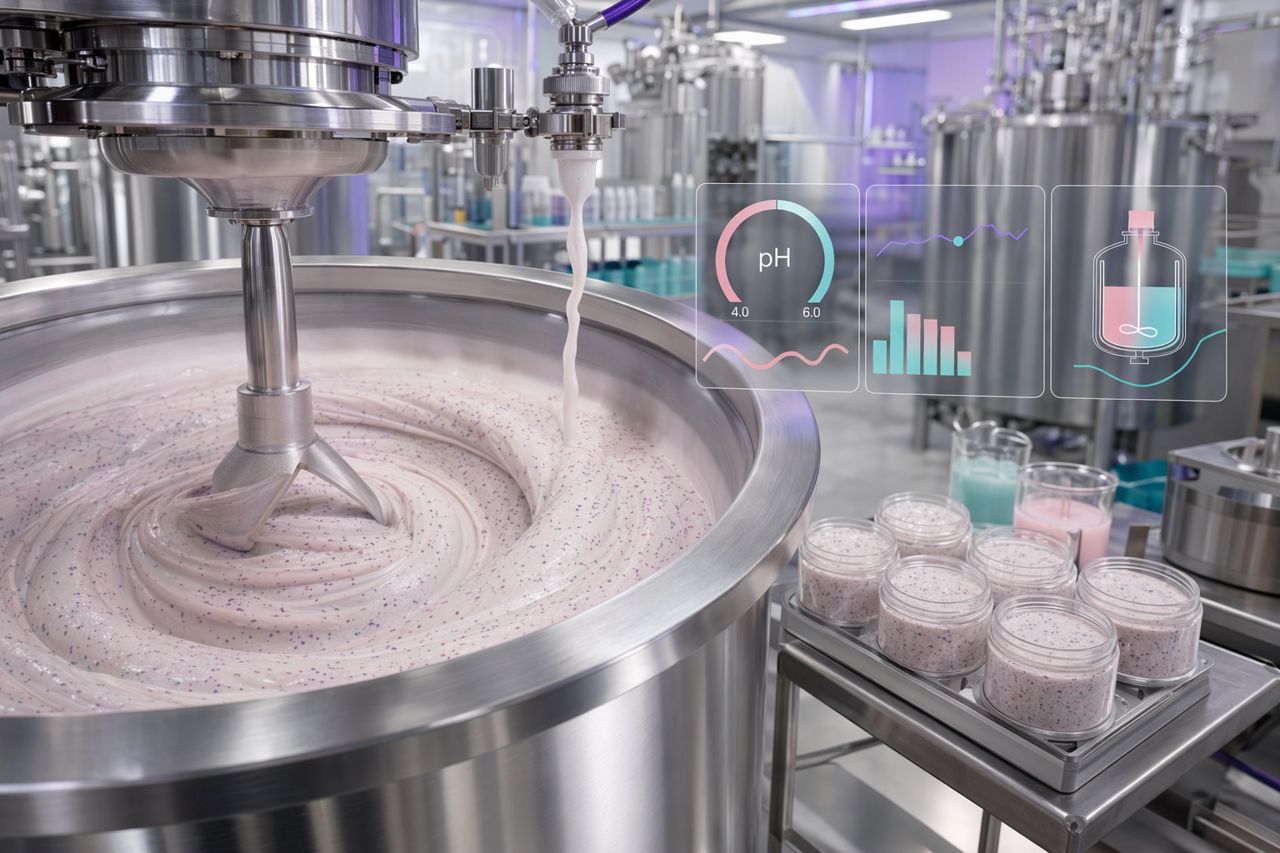
At lab scale, an enzyme polish may look stable and feel elegant. At factory scale, shear, blend order, hydration rate, air incorporation, filling temperature, and packaging exposure may reveal weaknesses.
Corneora’s approach is practical: understand the desired product format, the process constraints, and the commercial positioning before recommending an enzyme solution. The aim is fewer reformulation cycles and a cleaner path from concept brief to pilot batch.
A supplier relationship should make development easier for R&D, quality, regulatory, procurement, and production. For enzyme exfoliant projects, ask for support that goes beyond a product name.
Look for:
For buyers, this reduces risk. For formulators, it protects development time. For production, it helps avoid handling surprises. For brand teams, it supports a more credible finished-product story.
Before requesting samples or moving to pilot, align the team on these points:
This checklist helps turn an enzyme idea into a manufacturable product brief.
Corneora works with cosmetics manufacturers that need enzyme ingredients selected for real formulation behavior, not just label appeal. We support rinse-off exfoliant concepts where activity, stability, skin-feel, and processing conditions have to work together.
Whether you are building a luminous enzyme mask, a powder cleanser that activates at the sink, a creamy rinse-off polish, or a hybrid exfoliating treatment, Corneora can help identify the right enzyme direction and documentation package for your factory workflow.
If your team is sourcing an enzyme supplier for cosmetic exfoliant manufacturing, start with the product reality: base type, pH window, process, packaging, desired sensory finish, and launch scale.
Request a quote from Corneora and share your formulation brief with our team.
Tell us your application and volume — we reply with pricing and lead time.