Why powder masks are returning to premium skincare
Water-activated powder masks are back because they solve a problem premium skincare has never fully outgrown: how to deliver a sensorial, active exfoliation experience while preserving formulation elegance, shelf stability, and manufacturing control.
For a cosmetics manufacturer, the appeal is practical. A dry format can protect moisture-sensitive ingredients, reduce reliance on heavy preservation systems, and create a freshly activated ritual at the point of use. For the consumer, the format feels intentional: powder transforms into a creamy paste, a veil, or a soft polish with water. For the factory chemist, the format creates a different design space for enzyme exfoliation.
That is where Corneora fits: as an enzyme supplier for cosmetic exfoliant manufacturing focused on scalable, documentation-ready enzyme systems for refined skin-forward products.
The premium logic behind dry activation
Powder masks are not simply nostalgic. They are technically relevant because they separate activation from storage.
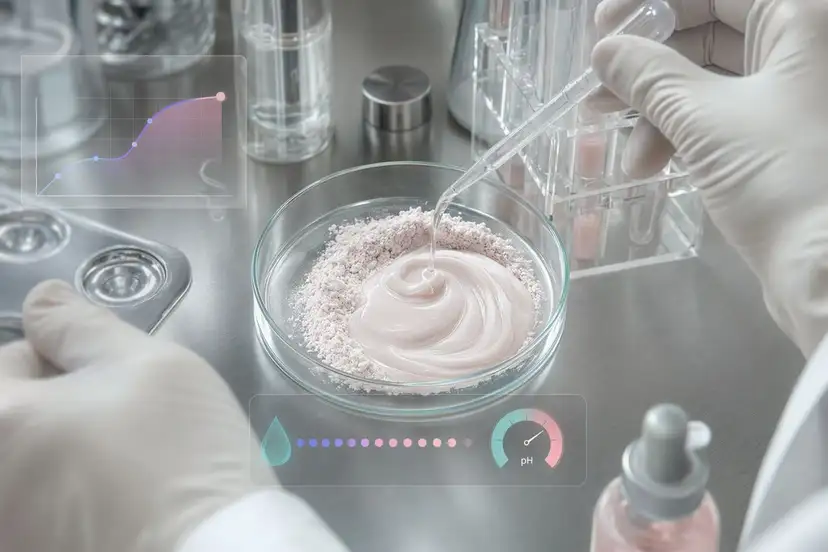
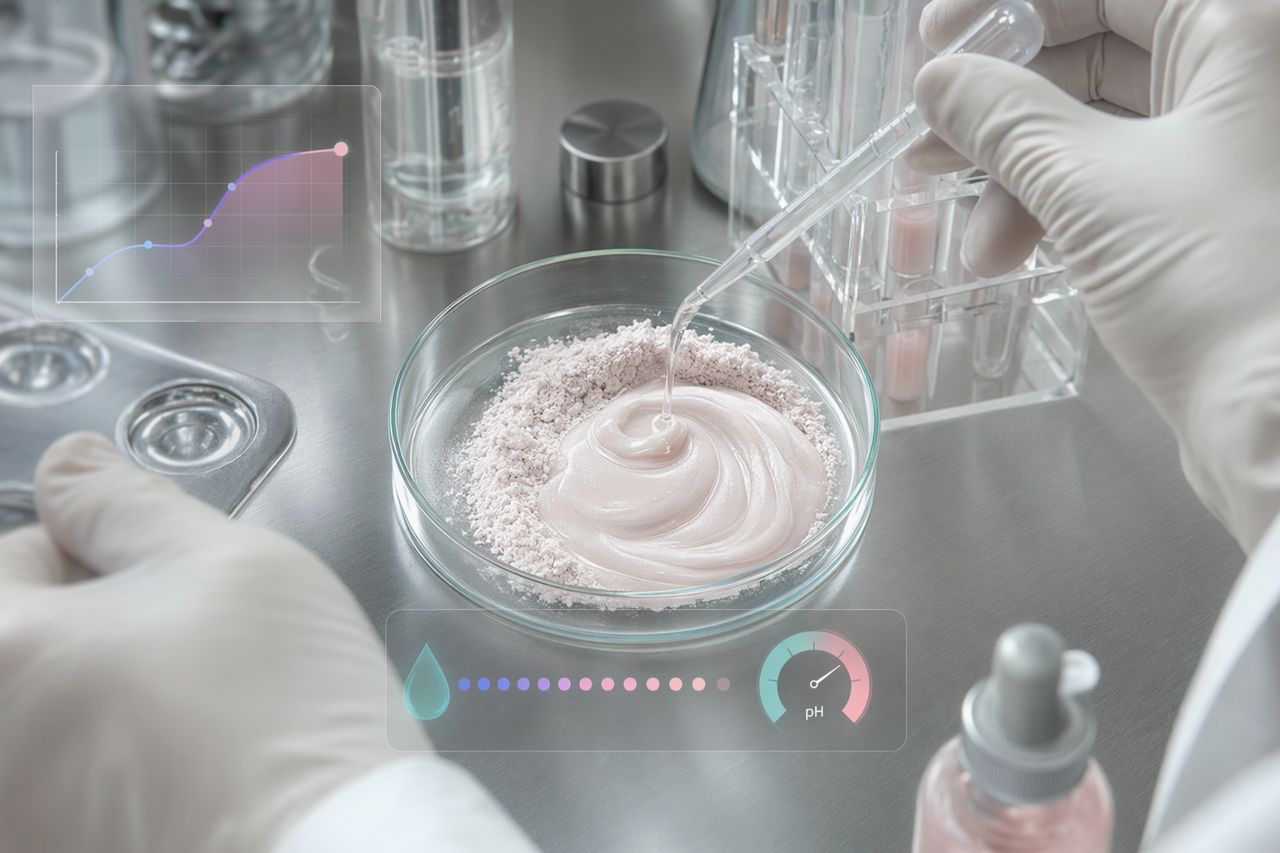
In an anhydrous or low-moisture powder system, enzyme selection, carrier choice, particle behavior, and blend uniformity become the levers that define product performance. Once the consumer adds water, the formula enters its active window: pH, hydration rate, contact time, and paste texture begin to shape the exfoliation profile.
For premium skincare, that matters because the desired result is not aggressive resurfacing. It is controlled smoothing, visible luminosity, and a refined after-feel.
What factories are trying to achieve
A successful water-activated enzyme mask should deliver:
- Consistent exfoliation behavior after hydration
- A smooth, non-scratchy paste or cream-like dispersion
- Predictable performance across pilot and production batches
- Compatibility with clays, starches, gums, mineral powders, and botanical carriers
- A pH window aligned with skin comfort and enzyme performance
- Stable dry-blend handling through filling, packing, and storage
- Documentation that supports supplier qualification, quality review, and scale-up
Premium buyers do not only ask, "Does it exfoliate?" They ask, "Can it exfoliate the same way across markets, batches, and consumer use conditions?"
Enzyme exfoliation is a formulation system, not a sprinkle-in ingredient
In powder masks, enzymes must be treated as part of a system. The enzyme, carrier, buffer strategy, powder base, fragrance approach, and intended use instructions all influence the final sensory and performance profile.
Proteolytic enzymes are often used to help loosen proteinaceous debris at the surface of the skin, supporting a smoother look without relying solely on abrasive particles. But in a dry mask, the elegance of that benefit depends on how quickly the powder wets, how evenly the active disperses, and whether the hydrated pH sits in the desired performance window.
Key formulation considerations
1. Hydration behavior
Water-activated formats must avoid clumping, uneven swelling, and hot spots of activity. The powder should wet cleanly and build a uniform texture quickly enough for a premium ritual.
2. pH window
The final hydrated paste should land in a controlled pH range that supports both skin comfort and enzyme function. This is especially important when the powder base includes clays, mineral salts, fruit powders, acids, or alkaline materials that can shift the final profile.
3. Carrier and blend uniformity
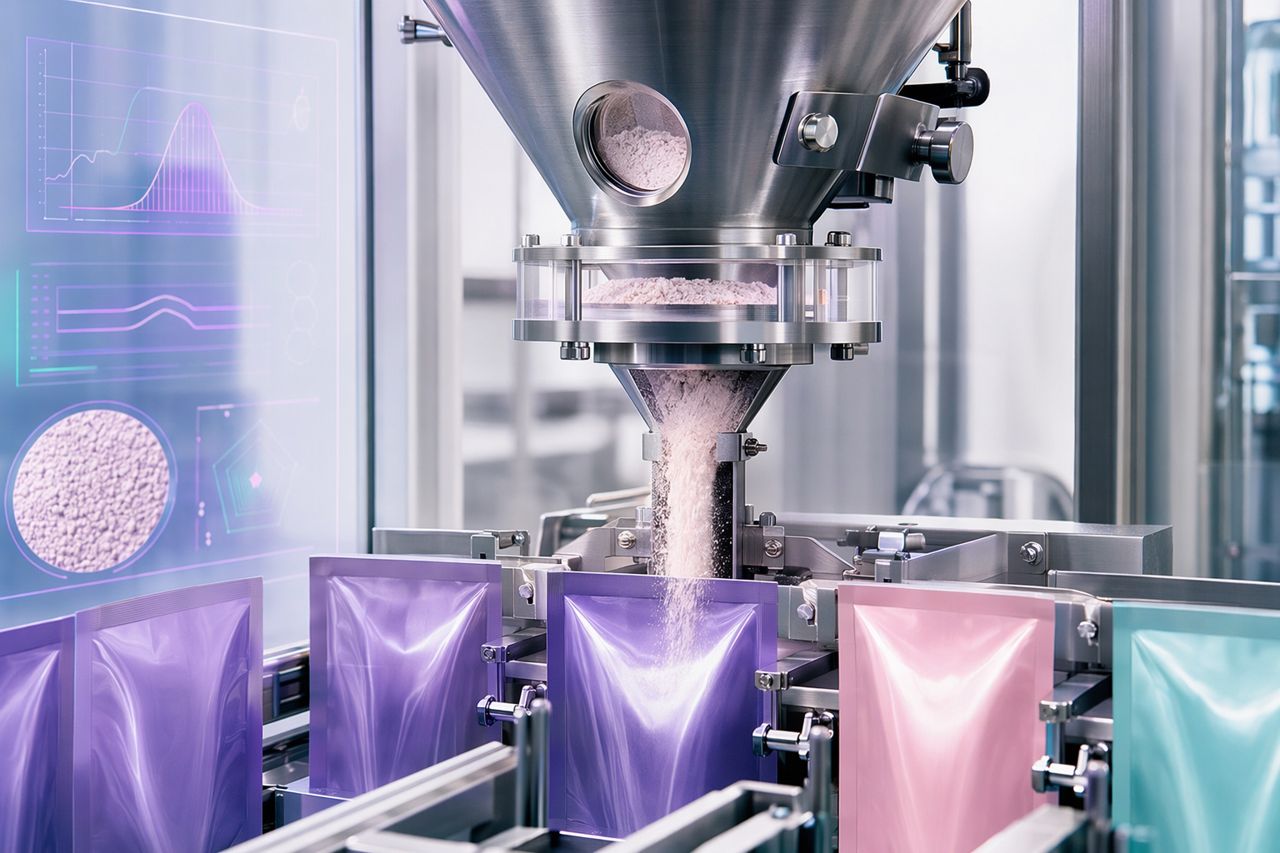
Enzyme distribution in dry powders affects consumer experience. A refined mask should not create one scoop that is mild and another that is too assertive. Carrier engineering and blending sequence are central to manufacturing consistency.
4. Skin-feel and rinse profile
Premium exfoliation is sensory. Enzymes should support a smooth, luminous result while the base controls cushion, slip, and rinse-down. The best systems feel clinical in performance and elegant in use.
5. Stability under real factory conditions
Powder masks face humidity, transport variation, filling friction, and packaging headspace. Enzyme systems should be selected with dry stability, handling robustness, and realistic storage conditions in mind.
Why this format works for modern skincare positioning
Water-activated masks create a strong bridge between laboratory credibility and consumer ritual. They also fit several current premium skincare directions:
- Freshly mixed treatment formats
- Reduced-water or waterless product concepts
- Minimalist preservation strategies
- Customizable texture through water dosage
- Visible sensorial transformation
- Gentle exfoliation narratives without harsh scrub perception
- Refill, sachet, jar, or professional-treatment pack concepts
For brand owners, the story is compelling. For manufacturers, the execution must be controlled.
Manufacturing realities that decide success
The most beautiful product concept can fail if the powder behaves poorly at scale. During development, Corneora encourages factories to evaluate the enzyme system in the actual production context, not only in a bench-top prototype.
Watch these scale-up points
- Does the enzyme blend distribute evenly in the full powder matrix?
- Does the product maintain flowability during filling?
- Does the mask hydrate consistently with consumer-level water addition?
- Does the pH remain within the intended range after typical mixing?
- Does the sensory profile stay elegant after accelerated and ambient storage?
- Does packaging protect against humidity ingress?
- Does the documentation package support procurement, quality, and regulatory review?
A premium powder mask is a manufacturing product before it becomes a consumer ritual.
Where Corneora supports cosmetic factories
Corneora supplies enzyme solutions for cosmetic exfoliant manufacturing with a focus on formulation control, stability, and industrial usability. We support factory teams that need more than a catalogue ingredient: they need an enzyme input that can move through development, purchasing, quality, and production without ambiguity.
Our support can help with
- Enzyme selection for powder mask positioning
- pH-window alignment for hydrated formulas
- Dry-blend handling considerations
- Compatibility discussion with common cosmetic powder bases
- Sensory and exfoliation consistency planning
- Batch-to-batch supply expectations
- Technical documentation for supplier qualification
- Scale-up conversations between R&D, production, and purchasing
We do not frame enzyme exfoliation as a miracle story. We frame it as controlled biochemistry inside a premium cosmetic system.
Practical development brief for a water-activated enzyme mask
When briefing an enzyme supplier, prepare the following details:
- Target product format: jar powder, sachet, professional treatment, refill, or hybrid base
- Intended consumer mixing ratio and use time
- Desired hydrated texture: paste, mousse, gel-cream, clay veil, or polishing mask
- Target pH range after activation
- Base composition: clays, starches, gums, minerals, acids, botanical powders, surfactants, or oils
- Fragrance and preservative strategy, if relevant
- Packaging format and humidity protection target
- Sensory goal: soft polish, brightening ritual, clarifying mask, or professional resurfacing feel
- Required documentation for factory onboarding
This kind of brief allows faster enzyme matching and fewer reformulation loops.
Embedded faceless explainer video
A one-minute faceless explainer can sit near the top of this article, showing enzyme droplets entering a pearlescent powder-to-paste system, abstract skin-cell layers lifting gently, and factory lab dosing scenes with subtitles. The visual language should feel luminous, clinical, and controlled, with no presenter or avatar.
The takeaway
Water-activated powder masks are returning because they offer premium skincare brands something rare: a visible ritual with real formulation logic behind it. For cosmetic manufacturers, the opportunity is strongest when the enzyme component is selected for dry-format stability, hydrated performance, skin-feel, and scale-up behavior from the start.
If your team is developing a premium powder mask, Corneora can help you qualify an enzyme system built for controlled exfoliation and manufacturing confidence.
Request a quote
Use the on-site request a quote form to tell us about your powder base, target pH window, packaging format, and desired exfoliation profile. Corneora will help identify the right enzyme supply path for your cosmetic manufacturing project.